
Manatee Youth Release Routes
Florida DJJ identifies Manatee Regional Juvenile Detention Center as a secure detention center serving Manatee, Sarasota, and Highlands counties. The center is in Bradenton, outside Sarasota County. Its regional role is why a Sarasota youth may be held there even though the adult county jail is in Sarasota. Secure juvenile detention is not an adult jail sentence, and the public adult SCSO arrest search is not the correct way to seek a child’s detention or release details.
A youth may leave secure detention under juvenile-court authority and return to a parent or guardian subject to conditions. Another outcome may place the youth in a DJJ commitment program or other approved setting. “Commitment” in juvenile justice refers to a court-ordered program after adjudication; it is not the same as release to the community. The exact court order and DJJ status control. Public copy should not name a youth or reveal protected facts merely because an adult record route would have shown similar fields.
Confirm Manatee Youth Release
Start with the person’s lawful relationship to the youth and the purpose of the request. Parents, guardians, and counsel can ask the assigned case contacts for current instructions. An authorized victim may use the notification route offered for the case. General members of the public may face limits on names, images, addresses, case documents, and placement information. A blank public search does not prove that the youth was never detained or has been released.
Use a narrow sequence:
- Contact counsel or the youth’s authorized DJJ contact for the current detention or placement status.
- Check the juvenile-court order through the Clerk only to the extent access is legally available.
- Ask whether departure was a guardian release, court-authorized placement, or DJJ commitment transfer.
- Use an authorized victim-notification channel when one applies to the case.
- Request only records that the agency may lawfully disclose to the requester.
The court order supplies legal authority. DJJ and the center track physical custody or placement. A guardian release can include conditions. A move to commitment is continued juvenile justice custody in a different form, not a community release. Keep those meanings separate.
Manatee Youth Center Contact
The official DJJ facility page identifies the center and its regional service area.
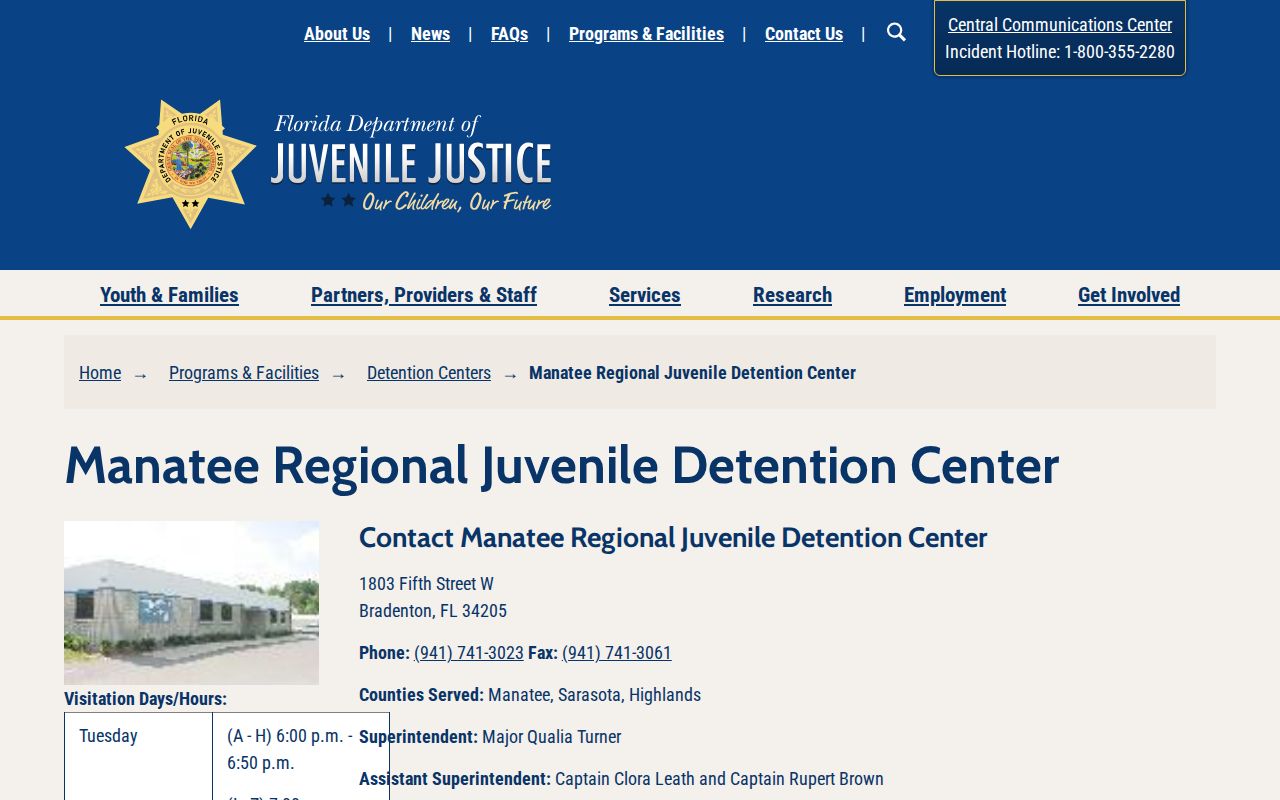
That source confirms the facility contact without turning it into an adult public roster. Call the center for routing, not to demand protected details.
Manatee Regional Juvenile Detention Center
1803 Fifth Street West
Bradenton, FL 34205
941-741-3023
Florida Department of Juvenile Justice
When contacting staff, state whether the caller is a parent, guardian, lawyer, or other authorized participant. Have the case number or DJJ identifier available when lawfully known. Staff may verify identity and authority before disclosing any fact. If a legal order or certified court copy is needed, the court or Clerk is the record custodian, subject to juvenile access rules.
Sarasota Juvenile Court Records
Sarasota County is part of Florida’s Twelfth Judicial Circuit. Juvenile matters can be automatically confidential or subject to remote-image restrictions. The Sarasota Clerk’s general court access cannot be treated as a complete youth release database. No result may reflect confidentiality, restricted access, an identity mismatch, or a matter held in another county. It does not support a broad conclusion about the youth.
The Sarasota Clerk Public Access office can explain the proper request route and what proof of authority is required. Ask for a specific order or docket entry rather than a broad file sweep. If the matter arose in Manatee rather than Sarasota, the proper clerk may be different. The facility’s regional service area does not decide the court venue by itself.
Orders should be read for both action and destination. “Release” may direct return to a guardian with supervision terms. “Placement” may send the youth to a program. “Commitment” generally places the youth under DJJ authority after adjudication. The physical handoff and the legal order should match, but each custodian can only certify its own record.
Note: Juvenile confidentiality protects more than online display, so do not republish restricted facts obtained through a private family or case channel.
Adult and Youth Records Differ
The adult Sarasota process centers on SCSO Booking, Florida VINE, ClerkNet, and county release records. The youth process centers on DJJ, juvenile court, counsel, guardians, and any authorized notification service. Using an adult arrest database for a child can misroute the search and invite false assumptions. Likewise, an FDC released-inmate result is for the state adult corrections system, not a DJJ detention record.
| Question | Correct youth route | Route to avoid |
|---|---|---|
| Current detention | Authorized DJJ or center contact | Adult SCSO roster |
| Release authority | Juvenile-court order | Adult booking disposition |
| New placement | DJJ case route or counsel | FDC prison search |
| Public court copy | Clerk access review | Assuming all ClerkNet images are open |
| Victim notice | Authorized case notification | Publishing youth data |
This distinction also changes the meaning of “released.” An adult county release can be described from a public booking sheet when available. A juvenile release may be legally known only to authorized people and may lead to a confidential placement. Accuracy requires restraint.
Manatee Youth Placement Meanings
Secure detention is a short-term custodial setting used within the juvenile process. Adjudication is the juvenile court’s determination, not an adult conviction label. Commitment is a court-ordered placement under DJJ authority. Community supervision permits a youth to live outside secure detention under set terms. These terms should be used only when the source order or DJJ record uses them.
- Detention
- Secure or supervised custody while a juvenile matter proceeds.
- Guardian release
- Departure to an approved parent or guardian under court-set terms.
- Commitment
- Court-ordered DJJ placement following the juvenile process.
- Placement
- The authorized program, home, or facility assigned for the next stage.
- Confidential record
- Information withheld or limited under law and court access rules.
None of these labels should be inferred from absence. Ask the source office for the exact wording it may disclose. If staff cannot discuss a placement with the caller, that limit does not itself establish the youth’s status.
Manatee Release Record Requests
A lawful request should identify an existing record and the requester’s authority. Useful details may include the youth’s legal name, date of birth, case number, approximate detention dates, and the specific order or custody event sought. Do not ask staff to create a narrative or confirm a guess. Ask which agency maintains the record and what consent, identification, or court authorization is needed.
For a court event, request the exact release, detention, placement, or commitment order from the proper Clerk. For a DJJ custody event, follow DJJ’s records process. For a facility operational fact, contact the center. An authorized request may still receive redactions. Chapter 119 does not make every juvenile field public, and confidentiality rules can outweigh general public access.
Certified proof may take a different route from a phone status check. Counsel can interpret an order and address urgent case questions. Facility staff can route operational inquiries but cannot replace legal advice. The Sarasota adult release search and records coverage should be used only if the person actually entered adult county custody, not simply because the underlying event occurred in Sarasota County.
Sarasota Youth Release Verification
Good verification matches four points: identity, legal authority, physical departure, and destination. In a juvenile case, some or all of those facts may be private. The answer should remain as narrow as the authorized source permits. A court order may authorize release while staff complete transportation or guardian checks. A facility departure may lead to a program rather than a home. A later supervision term may remain in force.
Do not rely on rumor, social media, an adult booking search, or a name-only court match. Avoid posting screenshots of youth details. If the question concerns immediate safety, use the official case contact or law enforcement channel supplied to the authorized participant. If it concerns a document, ask the correct custodian. If it concerns legal rights or access, contact counsel.
The most accurate outcome may be a limited confirmation rather than a public record. That is a feature of juvenile confidentiality, not a gap to work around.
Public Record Search
Sponsored Results